
Best Grocery Franchise in India (2026): Complete Buyer’s Guide, Investment, Profit & Top Opportunities
LATEST POST
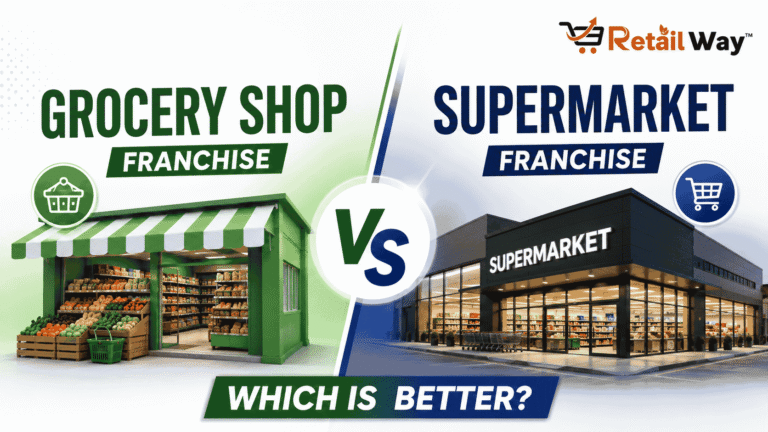
Fifteen years ago, if someone in a Tier-2 town told me they wanted to open a “supermarket”, I would have asked them to think twice. The supply chain wasn’t there. Credit terms from distributors were brutal. And customers still trusted the kirana uncle who gave them a month’s udhaar.
That conversation looks completely different today.
Grocery is the single largest slice of Indian household spending — food and daily essentials swallow a huge share of the monthly budget in almost every income bracket. What changed is not demand. Demand was always there. What changed is that organised retail finally built the back-end to serve it: cold chain, regional distribution centres, billing software that a 12th-pass cashier can operate, and payment systems that made ₹40 transactions viable without loose change.
The result is a steady shift of grocery spending from unorganised kirana counters toward branded, air-conditioned, self-service stores — and that shift is now visible well beyond metros. Some of the strongest store-level numbers I have seen in the last three years came from towns most people can’t place on a map: Muzaffarpur, Bilaspur, Ratlam, Hosur.
That is why the best grocery franchise in India is a genuinely serious question right now, and not a get-rich-quick one. Entrepreneurs are drawn to grocery because it is a cash business with daily sales, repeat customers, and no seasonality worth worrying about. People buy atta in December and in June. They buy it during a recession. They buy it when the stock market crashes.
But grocery is also one of the least forgiving retail categories. Margins are thin. Inventory rots. A single badly-chosen location can lock ₹20 lakh into a store that never crosses break-even.
This guide walks you through the entire decision: how the franchise model actually works, what different brands realistically expect from you, what the numbers look like once you strip out the marketing gloss, the licences you cannot skip, and the mistakes I watch first-time owners repeat every year.
Table of Contents
- What is a Grocery Franchise?
- Why Invest in a Grocery Franchise in India?
- Grocery Franchise vs Independent Grocery Store
- Best Grocery Franchise Opportunities in India
- How Much Investment is Required?
- Profit Margin in a Grocery Franchise
- Step-by-Step Process to Start a Grocery Franchise
- Documents Required
- Licences Required
- How to Choose the Best Grocery Franchise
- Common Mistakes to Avoid
- Future of the Grocery Franchise Business in India
- Why Retails Way Can Help You
- Conclusion
- FAQs
What is a Grocery Franchise?
A grocery franchise is an arrangement where a retail brand gives you the right to run a store under its name, using its systems, its supplier network and its pricing structure — in exchange for a fee, and usually an ongoing share of sales or margin.
You put in the capital. You sign the rent agreement. You hire the staff. You own the stock. The brand supplies the machinery around it: what to stock, at what price, from which vendor, on what software, with what shelf layout.
How the model works in practice
Most Indian grocery brands operate on some version of FOFO — Franchise Owned, Franchise Operated. You own the asset and run the day-to-day; the brand controls standards and supply.
A typical arrangement looks like this:
- You pay a one-time franchise fee, and often a refundable security deposit.
- The brand does a site survey before approving your location — footfall, catchment population, competing stores, parking, road width.
- Store design, racking layout and signage follow the brand’s specification.
- You buy stock through the brand’s designated supply chain, which is where most of your cost advantage comes from.
- Billing runs on the brand’s POS and inventory software, which also feeds them live sales data.
- You get launch support — training, opening-day promotions, sometimes a category manager who visits monthly.
Some brands charge a royalty on revenue. Others take their cut inside the product price, so your “royalty” is invisible — it sits in the wholesale rate you pay. Always ask which model you’re signing into. The second one looks cheaper and often isn’t.
The real benefits
- Buying power. A single independent store cannot negotiate the rate a 400-store network gets from HUL or ITC. This gap is the single biggest structural advantage of a franchise.
- A pre-built assortment. Deciding what 4,000 SKUs to stock is a genuinely hard problem. The brand has already solved it with data.
- Customer trust from day one. A recognisable board above the shutter shortens the trust-building period from years to weeks.
- Systems you don’t have to invent. Stock rotation rules, shrinkage control, staff SOPs, festive planograms.
- A phone number to call at 9 PM when the billing software crashes on a Saturday.
Why Invest in a Grocery Franchise in India?
The category is enormous and non-negotiable
Grocery is not discretionary spending. Households cut down on clothes, travel and electronics before they cut down on rice. That gives grocery retail a stability that very few other retail categories can claim.
Organised retail still has a long runway
Despite two decades of modern retail in India, the majority of grocery spending still happens at unorganised kirana counters. Every percentage point that shifts to organised formats represents a very large absolute number. You are not fighting for a share of a shrinking pie — you’re entering a category where the organised slice is still small enough to keep expanding for a decade.
Urbanisation and household structure
Nuclear families, working couples, apartment living, and the collapse of the “monthly ration from the wholesale market” habit have all pushed shoppers toward nearby self-service stores where they can compare, pick, and pay in fifteen minutes.
Tier-2 and Tier-3 markets are where the value sits now
Metro high streets are saturated and expensive. Rent in a Delhi or Mumbai retail location can eat your entire net margin. In a Tier-2 or Tier-3 town, the same 1,000 sq ft costs a fraction, competition is thinner, and brand-hungry customers are underserved. Most of the healthy store P&Ls I review now come from these markets.
Lower risk — but not “no risk”
A franchise reduces specific risks: wrong product mix, bad vendor terms, no brand pull. It does not eliminate the two risks that actually kill stores — bad location and bad operations. No franchisor can save a store on the wrong side of a divider road, and none can fix an owner who never shows up.
Be careful with anyone who tells you a grocery franchise is “risk-free” or “guaranteed profit”. That language is a warning sign, not a selling point.
Grocery Franchise vs Independent Grocery Store
Both models work. They suit different people. Here’s the honest comparison:
| Factor | Grocery Franchise | Independent Grocery Store |
|---|---|---|
| Initial investment | Higher — franchise fee, deposit, brand-spec interiors | Lower — you control every spend |
| Gross margin | Moderate, but stable and predictable | Can be higher on some SKUs, far more volatile |
| Marketing | Brand campaigns, launch support, festive offers ready-made | Entirely your cost and your effort |
| Brand trust | Instant recognition; customers walk in on day one | Built slowly over years through relationships |
| Supplier network | Ready supply chain, better rates, fewer vendor headaches | You negotiate with every distributor yourself |
| Risk | Lower operational risk; higher fixed-cost commitment | Lower fixed cost; higher risk of assortment and pricing errors |
| Support | Training, software, audits, category guidance | None. You learn by making expensive mistakes |
| Freedom | Limited — pricing, layout and assortment are governed | Complete control |
| Expansion | Straightforward — a proven format you can replicate | Harder; every new store is a fresh experiment |
| Exit value | A branded, systemised store is easier to sell | Value tied largely to you personally |
My rule of thumb: if you have retail experience, deep local supplier relationships, and the patience to build a name — an independent store can outperform. If you are entering retail for the first time, a franchise buys you a shortcut through the two years where most independent stores quietly fail.
Best Grocery Franchise Opportunities in India
Before the table, three things you must understand — because most “top franchise” articles online won’t tell you:
- Not every big grocery brand actually franchises. D-Mart (Avenue Supermarts) runs an almost entirely company-owned model; it is not a franchise opportunity in any conventional sense, regardless of what third-party sites claim. Reliance Retail works through partner and merchant arrangements in selected locations rather than a classic open franchise programme, and applications go through their official channels only.
- Some brands you’ll still see listed are legacy names. Easyday and Big Bazaar belonged to the Future Group ecosystem, which went through a well-documented financial collapse. Treat any franchise offer under those names with heavy caution and verify who currently owns and operates the brand.
- Investment figures floating on the internet are estimates, not quotations. I have seen the same brand listed at ₹2 lakh on one site and ₹1.5 crore on another. Both were guesses. The only number that matters is the one in the brand’s official franchise disclosure document.
With those caveats, here is the practical landscape:
| Brand / Model | Indicative Investment | Space Required | Franchise Fee | Typical ROI Window | Support Provided | Ideal For |
|---|---|---|---|---|---|---|
| Retail Way | Modular — depends on store size and city | ~500–1,000 sq ft | Disclosed at enquiry (GST applicable) | Varies by location & footfall | Supply chain access to 20,000+ products and 1,500+ brands, stock refill automation, staff hiring & training, branding support, backend software | First-time owners in Tier-2/Tier-3 towns wanting a smaller, manageable format |
| Reliance Retail formats (Smart Point, Fresh) | High; varies sharply by format and city | ~500–2,000+ sq ft | As per official partner terms | Longer, volume-driven | Strongest supply chain in Indian retail, private labels, national campaigns | Well-capitalised investors with prime, long-lease locations |
| More Retail | Moderate to high | ~1,500–3,500 sq ft | As per current agreement | Medium-term | Established neighbourhood supermarket format, category management | Investors targeting dense residential catchments and non-metro cities |
| Spencer’s Retail | Moderate to high | ~1,500–4,000 sq ft | As per current agreement | Medium-term | Curated assortment, fresh and gourmet strengths | Owners in premium urban catchments comfortable with tighter operations |
| Nature’s Basket | Premium-tier | ~1,500–3,000 sq ft | As per current agreement | Longer; niche-dependent | Gourmet and imported sourcing, premium positioning | Metro locations with genuinely affluent, food-focused catchments |
| Regional chains (Nilgiris, Vishal, Osia, state-level supermarket brands) | Wide range | ~500–5,000 sq ft | Highly variable | Often the fastest | Deep local supplier ties, regional taste understanding, lower entry barriers | Owners in a specific state where the regional name outranks national brands |
How to read this table: treat it as a shortlist tool, not a price list. Investment, space and ROI move dramatically with city tier, rent, format and how well the store is run. Two identical franchises three kilometres apart can produce completely different P&Ls. Always request the current franchise document directly from the brand and have a chartered accountant review the numbers before you commit capital.
How Much Investment is Required?
Here is where the money actually goes. These ranges reflect what I typically see for a 700–1,200 sq ft grocery franchise in a Tier-2 city. Metro costs run considerably higher; small-town costs can run lower.
| Cost Head | What it covers | Indicative Range |
|---|---|---|
| Franchise fee | One-time brand entry fee | ₹1,00,000 – ₹10,00,000+ |
| Security deposit | Refundable, held by franchisor | ₹50,000 – ₹5,00,000 |
| Rent deposit | Usually 3–6 months’ rent to the landlord | ₹1,50,000 – ₹6,00,000 |
| Civil work & interiors | Flooring, false ceiling, lighting, paint, façade | ₹3,00,000 – ₹12,00,000 |
| Racking & fixtures | Gondolas, end caps, checkout counter, baskets, trolleys | ₹2,00,000 – ₹6,00,000 |
| Refrigeration | Chillers, freezers, visi-coolers | ₹1,50,000 – ₹5,00,000 |
| Opening inventory | The single biggest line item | ₹8,00,000 – ₹25,00,000 |
| Technology & POS | Billing system, barcode scanners, printers, CCTV, UPS | ₹1,00,000 – ₹3,00,000 |
| Licences & registrations | GST, FSSAI, trade licence, professional fees | ₹15,000 – ₹60,000 |
| Launch marketing | Pamphlets, banners, opening offers, local digital | ₹50,000 – ₹2,00,000 |
| Working capital buffer | 3 months of salaries, rent, electricity, restocking | ₹3,00,000 – ₹8,00,000 |
Realistic all-in range: roughly ₹15 lakh to ₹60 lakh, depending on brand, format and city.
Two warnings from experience:
Do not under-budget the working capital buffer. This is the mistake that ends more stores than any other. New owners spend everything on a beautiful fit-out and full shelves, then discover that month two brings salaries, rent, electricity and a restocking bill before the store has found its rhythm. Keep three months of running cost untouched, in a separate account.
Electricity is not a small line. A grocery store with chillers, freezers and full lighting can run a five-figure monthly bill. Check the commercial tariff in your area before you sign the lease, not after.
Profit Margin in a Grocery Franchise
Let me be direct, because this section is where most articles start inventing numbers.
Gross margin in Indian grocery retail typically lands in the 12–20% band. Staples like atta, sugar, oil and rice run thin — sometimes 4–8%. FMCG packaged goods sit in the middle. The money hides in fresh produce, dairy, bakery, general merchandise and private-label products, which can carry 20–35%.
Net margin, after rent, salaries, electricity, shrinkage and royalty, usually settles between 4% and 10% for a well-run store. Anyone promising you 30% net margin in grocery is either confusing gross with net, or selling you something.
Here’s how that translates:
| Monthly Turnover | Gross Margin @ ~16% | Approx. Monthly Costs | Indicative Net Profit |
|---|---|---|---|
| ₹8,00,000 | ₹1,28,000 | ₹90,000 – ₹1,10,000 | ₹20,000 – ₹40,000 |
| ₹15,00,000 | ₹2,40,000 | ₹1,40,000 – ₹1,70,000 | ₹70,000 – ₹1,00,000 |
| ₹25,00,000 | ₹4,00,000 | ₹2,20,000 – ₹2,70,000 | ₹1,30,000 – ₹1,80,000 |
Illustrative only. Actual results depend entirely on location, rent, staffing efficiency, product mix and how tightly you control shrinkage.
Break-even for a healthy grocery franchise typically arrives somewhere between 18 and 36 months. Stores in strong catchments with reasonable rent hit it faster. Stores carrying metro-level rent take longer, sometimes much longer.
What actually moves profitability
- Rent as a percentage of sales. Keep it under 5% of turnover if you possibly can. Above 8%, the store struggles no matter how good everything else is.
- Shrinkage. Expiry, damage, pilferage. In grocery, 2% shrinkage is manageable; 5% quietly erases your entire net profit.
- Product mix. Two stores with identical turnover can have wildly different profits depending on how much fresh and non-food they sell.
- Owner presence. I have never seen an absentee-owned grocery store outperform an owner-operated one in the same catchment. Not once.
- Footfall conversion and basket size. Growing average basket value by ₹40 is often easier and cheaper than adding new customers.
Step-by-Step Process to Start a Grocery Franchise
- Research the category honestly. Spend two weeks visiting stores in your city. Stand outside at 7 PM and count footfall. Talk to owners. Ask them what they’d do differently. This costs nothing and teaches more than any report.
- Shortlist brands and verify them. Contact brands directly through official channels. Ask for the franchise disclosure document, existing franchisee references, and the exact commercial structure. Then actually call those franchisees.
- Plan your investment and arrange finance. Map every cost head. Add 20% contingency. If you’re taking a loan, check MSME and Mudra options — grocery retail is a well-understood lending category and banks are comfortable with it.
- Select the location. This decision matters more than the brand you pick. Assess catchment population, footfall pattern by hour, competing stores within 1 km, parking, road visibility, and the width of the entrance. Walk the area on a weekday evening and a Sunday morning — they tell you different stories.
- Negotiate the lease properly. Push for a longer lock-in in your favour, a capped annual escalation, and a clear exit clause. Get the property’s title and commercial usage permission verified by a lawyer.
- Sign the franchise agreement — after a lawyer reads it. Look specifically at territory protection, royalty structure, minimum purchase obligations, termination clauses, and what happens if you want to exit in year three.
- Complete registrations and licences. Start early; FSSAI and trade licence timelines vary by state and can delay your opening.
- Execute the store setup. Civil work, racking, refrigeration, signage, POS installation. Budget 4–8 weeks and expect it to overrun slightly.
- Hire and train the team. For 1,000 sq ft you typically need 4–6 people across shifts. Hire for reliability and attitude; the brand will handle skills training.
- Build opening inventory strategically. Resist the urge to fill every shelf. Overstocking slow movers on day one locks up cash you’ll badly want in month two.
- Run a proper local launch. Society WhatsApp groups, RWA tie-ups, pamphlet distribution in a 2 km radius, an opening offer that brings people in without destroying your margin, and a Google Business Profile set up correctly with photos and hours.
- Review the numbers weekly for the first six months. Category-wise sales, shrinkage, footfall, basket size. Fix what the data tells you, not what your instinct tells you.
Documents Required
| Document | Purpose |
|---|---|
| PAN Card (individual/entity) | Mandatory for all tax registrations |
| Aadhaar Card | Identity verification and KYC |
| Passport-size photographs | Applications and franchise onboarding |
| Address proof (utility bill/passport) | Applicant verification |
| Property documents or registered rent agreement | Proves lawful possession of the store premises |
| NOC from property owner | Required for several licence applications |
| Bank account details and cancelled cheque | Settlements and vendor payments |
| Last 6 months’ bank statements | Financial capability assessment by the franchisor |
| ITR of last 2–3 years | Creditworthiness and loan processing |
| Partnership deed / MOA & AOA / LLP agreement | If applying as a firm or company |
| Layout plan of the premises | Franchisor site approval and licensing |
| Site photographs | Franchisor’s site evaluation |
| Signed franchise agreement | The core legal contract |
Licences Required
| Licence / Registration | Issuing Authority | Why You Need It | Notes |
|---|---|---|---|
| GST Registration | GST Department | Mandatory for retail sales above threshold; required by all franchisors | Get this before you place your first stock order |
| FSSAI Licence | Food Safety and Standards Authority of India | Compulsory for selling packaged and fresh food | State licence for most single stores; registration for very small outlets |
| Shop & Establishment Registration | State Labour Department | Governs working hours, employment, holidays | State-specific; usually quick and online |
| Trade Licence | Local municipal corporation | Permission to run a commercial establishment at that address | Renewal is typically annual |
| PAN Card | Income Tax Department | Required for all business tax matters | Entity PAN if you register a company/LLP |
| Current Bank Account | Any commercial bank | Business transactions, vendor settlements, POS credits | Keep it separate from personal accounts |
| Fire Safety NOC | State Fire Department | Required for larger formats and certain buildings | Applicability depends on area and floor |
| Weights & Measures (Legal Metrology) | State Legal Metrology Dept. | Mandatory if you sell loose goods by weight | Weighing scales need periodic stamping |
| Professional Tax Registration | State authority | Applicable in states like Maharashtra, Karnataka, WB | Not applicable everywhere |
| ESI & PF Registration | EPFO / ESIC | Once staff strength crosses the statutory threshold | Plan for it before you scale the team |
| Udyam (MSME) Registration | Ministry of MSME | Optional but enables subsidised credit and schemes | Free and takes minutes |
Rules vary by state and by municipal body. Verify current requirements locally, or work with a CA who handles retail registrations regularly — the ₹10,000 you spend there saves months of avoidable trouble.
How to Choose the Best Grocery Franchise
Match the investment to your actual capacity — not your ambition. Committing every rupee you have, plus a loan against your house, into a first store is how good businesses get killed by a single slow quarter. Enter at a level where a bad six months is survivable.
Check the brand’s reputation from the inside. Reviews and websites tell you nothing useful. Call five existing franchisees — ideally ones the brand did not introduce you to. Ask about supply delays, margin disputes, and whether the promised support actually shows up.
Interrogate the supply chain. How far is the nearest distribution centre? What’s the replenishment cycle? What happens if a fast-moving SKU is out of stock at their warehouse during Diwali week? This is the difference between a profitable store and a frustrating one.
Evaluate the support structure honestly. Training before opening is standard. What you want to know is what happens in month seven, when the launch buzz has faded and sales have plateaued. Is there a category manager who visits? A performance review? Or does support quietly mean a helpdesk email?
Treat location as a make-or-break decision. A mediocre brand in a great location beats a great brand in a mediocre one, almost every time. Don’t let a franchisor talk you into approving a site you have doubts about.
Understand the technology stack. Good POS and inventory software is not a luxury in grocery. Without live stock visibility and expiry tracking, shrinkage will eat you alive.
Read the exit and expansion terms. What happens if you want a second store? Do you get territorial rights? What if you want out in year three — can you sell the store, and does the brand have first refusal?
Ask what isn’t in the brochure. Minimum purchase commitments. Mandatory renovation cycles. Marketing contributions. Software subscription fees. These recurring costs shape your P&L more than the headline franchise fee does.
Common Mistakes to Avoid
- Choosing the location after choosing the brand. Do it the other way round. Find the catchment first, then find the brand that fits it.
- Signing a lease with a steep annual escalation. A 10% yearly rent hike on a business with 6% net margin is a slow-motion disaster.
- Running out of working capital. Repeating this because it’s the number one killer. Three months of running costs, untouched.
- Overstocking at launch. Cash sitting in slow-moving SKUs is cash you can’t use when you need it.
- Ignoring expiry management. Set a weekly near-expiry audit from week one. Discount early rather than write off later.
- Hiring the cheapest staff available. In a self-service grocery format, shrinkage and customer experience both live or die with your team.
- Treating it as passive income. Absentee ownership and grocery retail do not go together. Plan to be present daily for the first year.
- Believing “guaranteed profit” claims. No legitimate franchisor guarantees returns. Anyone who does is telling you something important about themselves.
- Skipping legal review of the agreement. A lawyer costs a fraction of what an unfavourable termination clause will.
- Competing on price against the biggest chains. You cannot win that fight. Compete on freshness, service, proximity and local relationships.
- Neglecting your Google Business Profile. A large share of “grocery store near me” searches decide where someone walks. Claim it, add photos, keep hours accurate.
Future of the Grocery Franchise Business in India
Quick commerce has changed the rules — but not the game. Ten-minute delivery apps have taken a real bite out of top-up purchases in metros: the ₹150 emergency basket of milk, bread and eggs. What they have not taken is the weekly and monthly shop, the fresh produce a customer wants to touch before buying, and the entire non-metro market where delivery economics still don’t work well.
Hybrid retail is where the smart operators are heading. The stores I see performing best now run a physical store and a WhatsApp ordering channel with local delivery within 2 km. The store becomes both a shopfront and a micro-fulfilment point. Setup cost: almost nothing. Impact on basket size: substantial.
Technology is separating good stores from average ones. Demand forecasting, automated reordering, loyalty programmes tied to phone numbers, digital khata for regulars. These used to be enterprise features. They now come bundled with decent franchise POS systems, and owners who use them properly outperform owners who treat the POS as a billing machine.
Private labels will keep growing. Brand-owned staples, snacks and household products carry noticeably better margins than national FMCG brands. As Indian shoppers grow comfortable with store brands, this becomes a meaningful profit lever for franchisees.
Tier-2 and Tier-3 towns are the real opportunity for the next several years. Lower rent, thinner competition, aspirational customers, and improving logistics infrastructure. If I were advising someone entering grocery retail today with ₹25–40 lakh, I would point them toward a good catchment in a growing district town well before a metro high street.
Consumer behaviour keeps shifting toward experience. Clean floors, working AC, clear signage, no queues at billing, easy returns. These sound trivial. They are exactly what pulls a customer away from a kirana shop that has served their family for twenty years.
Why Retails Way Can Help You
Most people evaluating a grocery franchise get stuck at the same point: the information available online is inconsistent, and the brands themselves only talk about their own offering. Nobody gives you a straight comparison.
Retails Way operates in that gap. It runs its own supermarket franchise model in India while also helping entrepreneurs understand the wider landscape before they commit capital.
What that looks like practically:
- Format guidance for realistic budgets. The Retail Way model works at around 500–1,000 sq ft, which suits first-time owners and Tier-2/Tier-3 locations far better than large-format stores that demand crores of capital.
- Supply chain access. Franchise partners get access to a network spanning 20,000+ products across 1,500+ brands — the buying leverage an independent store simply cannot build alone.
- Site evaluation before you commit. Their process includes assessing local demographics, spending patterns and footfall before a location is approved. Given how much of a grocery store’s outcome is decided by location, this step matters more than most people realise.
- Documentation and compliance support. GST, food licences, rent agreements, local registrations and the franchise agreement handled as a structured process rather than a scramble.
- Operational support after opening. Stock refill planning, staff hiring and training, backend software, and local branding help — the part that determines whether year two is better than year one.
- A budget planning tool on their site that lets you model franchise fee, deposit, software, purchase and interior costs before you talk to anyone.
If you want to understand what’s realistic for your city, budget and risk appetite, a conversation with their team is a reasonable starting point — including if you ultimately decide a different brand or an independent store suits you better.
Conclusion
Choosing the best grocery franchise in India is less about finding the biggest name and more about finding the right fit between four things: your capital, your location, your appetite for daily involvement, and the brand’s ability to actually support you after the opening ribbon is cut.
The fundamentals are genuinely strong. Grocery demand doesn’t disappear. Organised retail still has a long way to grow, particularly outside the metros. Supply chains and technology have matured to the point where a first-time owner in a district town can run a professional store — something that wasn’t realistic fifteen years ago.
But the numbers demand respect. Gross margins in the mid-teens. Net margins in single digits for most stores. Break-even measured in years, not months. This is a business built on discipline, presence and small daily improvements, not on a single clever decision.
Do the unglamorous work first. Count footfall yourself. Call existing franchisees the brand didn’t select for you. Have a lawyer read the agreement and a CA read the numbers. Protect your working capital as though the business depends on it — because it does.
If you’re at the stage of comparing options, Retails Way is a useful resource for entrepreneurs looking at grocery and supermarket franchise opportunities in India — for understanding formats and budgets, for site evaluation, and for the operational support that matters once the store is running. Take your time with the decision. A grocery store built carefully can support a family for a generation; one built in a hurry rarely lasts three years.
Frequently Asked Questions
1. Which is the best grocery franchise in India?
There is no single answer, and be sceptical of anyone who gives you one. The right choice depends on your budget, your city tier, the size of space you can secure, and how involved you plan to be. Large national formats offer supply chain strength but demand heavy capital and prime locations. Smaller formats such as Retail Way work well for first-time owners in Tier-2 and Tier-3 towns with 500–1,000 sq ft. Strong regional chains sometimes outperform national brands in their home states because of local trust and supplier depth. Shortlist three brands, speak to their existing franchisees directly, and compare the actual agreements rather than website claims.
2. How much investment is needed for a grocery store franchise in India?
For a typical 700–1,200 sq ft store in a Tier-2 city, the realistic all-in figure runs from about ₹15 lakh to ₹60 lakh. That covers the franchise fee, security deposit, rent deposit, interiors and racking, refrigeration, opening inventory, POS and technology, licences, launch marketing, and a working capital buffer. Opening inventory is usually the single largest line item. Metro locations cost considerably more, mainly because of rent and fit-out standards. Always budget three months of running costs separately and never touch that buffer — underestimating working capital is the most common reason new grocery stores fail in their first year.
3. Is a grocery franchise actually profitable?
It can be, provided your expectations are grounded. Gross margins in Indian grocery retail typically fall between 12% and 20%, with staples on the lower end and fresh produce, dairy, bakery and private labels on the higher end. After rent, salaries, electricity, shrinkage and royalty, net margins usually land between 4% and 10% for a well-run store. Break-even commonly arrives between 18 and 36 months. Profitability is driven far more by rent as a percentage of sales, shrinkage control, product mix and owner presence than by which brand board hangs above the door. Treat any promise of guaranteed or very high returns as a warning sign.
4. Which licences are required to open a grocery franchise?
The essentials are GST registration, an FSSAI food licence, Shop & Establishment registration, a municipal trade licence, PAN, and a current bank account. Depending on your state, format and store size, you may also need a fire safety NOC, Legal Metrology registration if you sell loose goods by weight, professional tax registration, and ESI/PF registration once your staff crosses the statutory threshold. Udyam (MSME) registration is optional but useful for accessing subsidised credit. Requirements and timelines vary by state and municipal body, so start the process early — FSSAI and trade licence delays are a frequent cause of postponed store openings.
5. Can I open a grocery franchise in a small town or Tier-3 city?
Yes, and in many cases that’s where the better economics currently sit. Rent in smaller towns is a fraction of metro costs, competition from organised retail is thinner, and quick-commerce apps have limited penetration — which means less pressure on top-up purchases. Customers in these markets are often actively looking for a clean, well-stocked, branded store. What matters is choosing a format sized for the catchment rather than copying a metro store, and picking a brand whose supply chain genuinely reaches your district. Verify replenishment frequency to your location before signing anything; a strong brand with weak local logistics will cause constant stockouts.