
Table of Contents
- What is a Grocery Shop Franchise?
- What is a Supermarket Franchise?
- Grocery Shop Franchise vs Supermarket Franchise: Full Comparison
- Investment Comparison
- Profit Margin Comparison
- Advantages of a Grocery Shop Franchise
- Advantages of a Supermarket Franchise
- Challenges of Both Business Models
- Which Business is Better for Different Investors?
- Factors to Consider Before Choosing
- Common Mistakes to Avoid
- Expert Tips Before Investing
- Final Verdict
- Why Choose Retails Way?
- Conclusion
- FAQs
A few years ago I sat with a client in Gorakhpur who had ₹45 lakh ready and a very clear idea in his head. He wanted a supermarket. Big shutter, wide aisles, trolleys, the works. He had seen one in Lucknow and wanted the same thing in his town.
We spent an afternoon standing outside the shop he had shortlisted, counting people. The catchment simply wasn’t there yet. The road carried footfall, but not the kind that fills a trolley. What the neighbourhood actually wanted was a clean, well-stocked, 800 sq ft store within walking distance that stocked everything they needed for the week.
He opened that instead. Three years later he has two of them, and he is now finally in a position to build the supermarket he originally wanted — funded by the smaller stores, in a location he understands far better.
That story sits at the heart of this question. A grocery shop franchise and a supermarket franchise are not two rungs of the same ladder where one is simply the “better” version. They are two different businesses that happen to sell similar products. They demand different capital, different skills, different catchments, and different levels of daily involvement from the owner.
India’s grocery retail sector is growing fast enough that both models have room to succeed. Organised retail still accounts for a minority of total grocery spending, which means the runway is long — particularly outside the metros, where rent is manageable and modern stores are still a novelty. Nuclear families, working couples, better logistics and UPI-everywhere have all pushed shoppers toward branded self-service formats.
The problem is that most first-time investors compare these two models on a single axis: how much does it cost. That’s the least useful question you can ask.
This guide compares them properly — on investment, margin structure, staffing, operating cost, risk, scalability and, most importantly, which type of investor and which type of location each one actually suits.
What is a Grocery Shop Franchise?
A grocery shop franchise is a neighbourhood-format retail store run under an established brand name, focused on daily and weekly essentials rather than a full shopping trip.
Think of it as the organised version of the kirana store — same convenience and proximity, but with barcode billing, fixed pricing, self-service shelves, standardised stock, and a supply chain behind it that a single owner could never build alone.
How it works
You sign a franchise agreement, pay a one-time fee and usually a refundable deposit, and set up the store to the brand’s specification. Stock comes through the brand’s designated supply network. Billing runs on their software. In return you get their buying rates, their assortment logic, their signage and their operational support.
Most grocery shop franchises in India run on a FOFO model — Franchise Owned, Franchise Operated. You own the store and run it daily; the brand governs standards and supply.
Typical store size
Usually 300 to 1,200 sq ft. Many of the better-performing formats sit in the 500–1,000 sq ft band, which is large enough for a proper self-service layout with 3,000–6,000 SKUs, and small enough that one owner and a team of three or four can run it without a management layer.
Investment approach
Capital is moderate and, crucially, modular. The single biggest cost is opening inventory, and inventory scales with shelf space. A smaller footprint means less rent deposit, fewer fixtures, lighter refrigeration and a smaller stock investment — which is why this format is realistic for someone with ₹15–25 lakh rather than a crore.
Target customers
Households within roughly a 1–1.5 km radius. These are repeat customers who visit two to four times a week, buy a basket of ₹200–₹700, and choose you primarily because you are close, reliably stocked and fairly priced. You are not competing for the once-a-month bulk shopper. You are competing for habits.
What is a Supermarket Franchise?
A supermarket franchise is a large-format, destination store. Customers plan a trip to it, park, take a trolley, and spend twenty to forty minutes filling it.
Store format
Typically 2,000 to 8,000 sq ft, sometimes larger. Wide aisles, multiple billing counters, a dedicated fresh section, significant refrigeration, and often a small non-food area covering utensils, plastics, stationery and seasonal merchandise.
Product range
This is the fundamental difference. Where a grocery shop stocks 3,000–6,000 SKUs, a supermarket may carry 10,000 to 25,000. That includes depth within categories — not one brand of olive oil but five, not two varieties of rice but a dozen. It also means fresh fruit and vegetables, a proper dairy and frozen section, bakery, and general merchandise that a small format simply cannot accommodate.
Customer experience
The supermarket sells an experience as much as a product list. Air conditioning, clean floors, clear category signage, trolleys, offer displays, no queue at billing. Customers come with a list and expect to find everything on it in one visit. Failing that expectation is expensive — a shopper who can’t complete their list starts planning their trip elsewhere.
Business model
Higher fixed costs, higher volumes, thinner unit margins on staples, and profit driven by scale plus category mix. A supermarket earns disproportionately from fresh produce, dairy, bakery, general merchandise and private-label products, while staples like atta, sugar and oil are often stocked at very thin margins to establish price credibility.
Operationally, it’s a management job rather than a shopkeeping job. You are running shifts, a department structure, cold chain, shrinkage control and a team of eight to twenty people. That distinction matters more than most first-time investors expect.
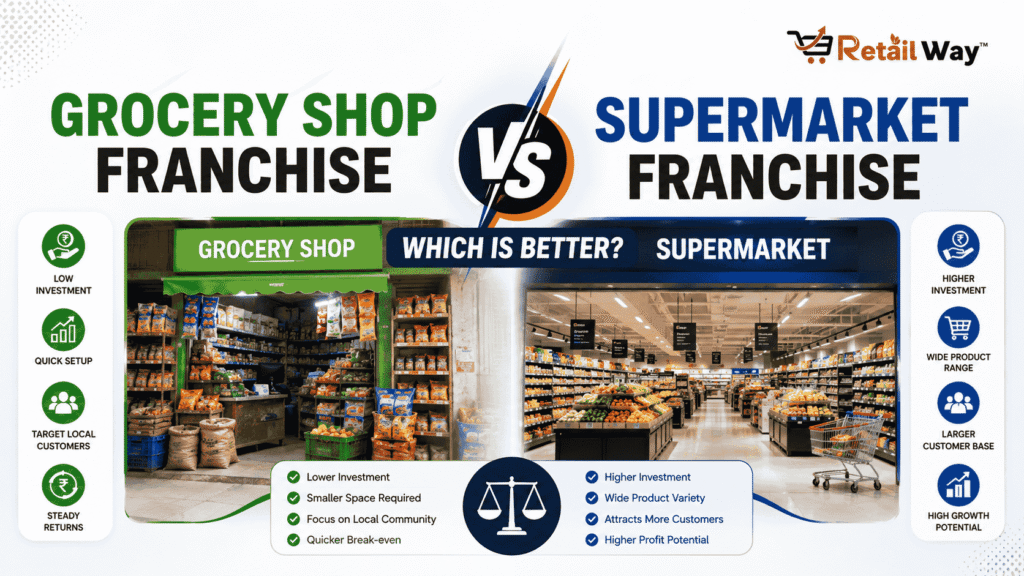
Grocery Shop Franchise vs Supermarket Franchise: Full Comparison
| Parameter | Grocery Shop Franchise | Supermarket Franchise |
|---|---|---|
| Business model | Neighbourhood convenience; habit-driven repeat visits | Destination retail; planned weekly or monthly shopping trips |
| Store size | ~300–1,200 sq ft | ~2,000–8,000+ sq ft |
| Initial investment | Moderate; roughly ₹12–30 lakh typical | Substantial; roughly ₹40 lakh–₹1.5 crore+ |
| Product range | 3,000–6,000 SKUs; essentials-focused | 10,000–25,000 SKUs; wide and deep across categories |
| Inventory | Fast-moving, high-rotation stock; lower cash locked | Large investment locked in stock; slower-moving long tail |
| Profit potential | Lower absolute profit, healthier margin on smaller base | Higher absolute profit potential; thinner unit margins |
| Operating cost | Low — modest rent, small team, limited refrigeration | High — large rent, bigger payroll, heavy electricity and cold chain |
| Staff requirement | 3–6 people | 8–20+ people across departments and shifts |
| Technology | Basic POS, inventory and barcode system | Full retail ERP, category analytics, loyalty, multi-counter billing |
| Customer experience | Quick, familiar, personal; in-and-out in five minutes | Structured, comfortable, wide-choice; a longer visit |
| Supplier support | Brand supply chain covers most essentials | Brand supply chain plus direct vendor and local fresh sourcing |
| Marketing | Local and low-cost: pamphlets, WhatsApp groups, RWA tie-ups | Broader: local media, festive campaigns, loyalty programmes, digital |
| Expansion opportunities | Easy to replicate; a cluster of 3–5 stores is realistic | Slower and capital-heavy; each new store is a large commitment |
| Risk level | Lower — smaller fixed costs, faster to correct mistakes | Higher — a bad location or slow ramp-up is very expensive |
| Ideal owner | First-timer, owner-operator, limited capital, Tier-2/Tier-3 focus | Experienced retailer or well-capitalised investor able to manage a team |
The row that deserves the most attention is operating cost. A grocery shop that has a bad month loses a manageable amount. A supermarket with high rent and a twelve-person payroll burns cash quickly when sales dip. That difference in downside — not the difference in upside — is what should shape a first-time investor’s decision.
Investment Comparison
These ranges reflect what I typically see for a Tier-2 city. Metro numbers run considerably higher, mainly on rent and fit-out. Small-town numbers can run lower.
| Cost Head | Grocery Shop Franchise (~800 sq ft) | Supermarket Franchise (~3,000 sq ft) |
|---|---|---|
| Franchise fee | ₹1,00,000 – ₹5,00,000 | ₹3,00,000 – ₹15,00,000 |
| Security deposit (franchisor) | ₹50,000 – ₹2,00,000 | ₹2,00,000 – ₹10,00,000 |
| Rent deposit (landlord) | ₹1,00,000 – ₹4,00,000 | ₹4,00,000 – ₹18,00,000 |
| Civil work & interiors | ₹2,50,000 – ₹7,00,000 | ₹10,00,000 – ₹35,00,000 |
| Racking & fixtures | ₹1,50,000 – ₹4,00,000 | ₹6,00,000 – ₹18,00,000 |
| Refrigeration & cold chain | ₹1,00,000 – ₹3,50,000 | ₹5,00,000 – ₹20,00,000 |
| Opening inventory | ₹6,00,000 – ₹15,00,000 | ₹20,00,000 – ₹60,00,000 |
| Technology & POS | ₹80,000 – ₹2,00,000 | ₹2,50,000 – ₹8,00,000 |
| Licences & professional fees | ₹15,000 – ₹50,000 | ₹40,000 – ₹1,50,000 |
| Launch marketing | ₹40,000 – ₹1,50,000 | ₹1,50,000 – ₹6,00,000 |
| Working capital buffer (3 months) | ₹2,50,000 – ₹6,00,000 | ₹8,00,000 – ₹20,00,000 |
| Indicative total | ₹12 lakh – ₹30 lakh | ₹45 lakh – ₹1.5 crore+ |
Why the actual figure varies so much
Rent is the biggest swing factor. The same 3,000 sq ft costs wildly different amounts in Andheri, Indore and Hoshiarpur. Rent also determines your deposit, which is often three to six months upfront.
Fit-out standards differ by brand. Some franchisors specify premium flooring, branded façades and specific lighting. Others allow a functional build. This alone can change interior costs by two or three times.
Inventory depends on assortment, not just size. A store carrying deep fresh and frozen ranges locks in far more capital than one focused on packaged staples.
Existing property changes everything. If you own the premises, remove the rent deposit and a large monthly cost from the model. This single factor makes a supermarket viable for many investors who otherwise couldn’t sustain one.
The condition of the space matters. A raw shell needs full civil work. A previously-fitted retail space might need only cosmetic changes.
Treat every figure above as a planning range, not a quotation. The only numbers that count are the ones in the brand’s official franchise disclosure document, reviewed by your CA. If you want a fuller breakdown of licences, documentation and brand-level options, our complete grocery franchise buyer’s guide covers that ground in detail.
Profit Margin Comparison
Let me be plain about this, because grocery is a category where optimistic numbers get repeated until people believe them.
Average margins
Gross margin in Indian grocery retail generally falls between 12% and 20% for both formats. Staples run thin — often 4–8% on atta, sugar, oil and rice. Packaged FMCG sits in the middle. The healthier margins live in fresh produce, dairy, bakery, general merchandise and private-label products, which can carry 20–35%.
Here’s the nuance most comparisons miss: a supermarket usually achieves a slightly better blended gross margin than a grocery shop, because it can carry the high-margin categories a small format has no room for. But it also carries far higher fixed costs. So the two formats often end up at similar net margins — reached by completely different routes.
Net margin for a well-run store in either format typically lands between 4% and 10%. Anyone quoting 25–30% net margin in grocery retail is confusing gross with net, or selling something.
Monthly expenses
| Expense | Grocery Shop Franchise | Supermarket Franchise |
|---|---|---|
| Rent | ₹25,000 – ₹70,000 | ₹1,20,000 – ₹5,00,000 |
| Salaries | ₹40,000 – ₹90,000 | ₹1,80,000 – ₹6,00,000 |
| Electricity | ₹12,000 – ₹30,000 | ₹60,000 – ₹2,50,000 |
| Software, maintenance, misc. | ₹10,000 – ₹25,000 | ₹40,000 – ₹1,20,000 |
Revenue opportunity
A healthy grocery shop franchise in a decent catchment commonly runs ₹6–18 lakh monthly turnover. A supermarket in a proven location may run ₹25 lakh–₹1 crore+. The absolute profit ceiling is clearly higher for the supermarket — but so is the floor you must cross before you see any profit at all.
Break-even timeline
- Grocery shop franchise: typically 12–30 months
- Supermarket franchise: typically 24–48 months
Smaller formats reach break-even faster because the monthly nut is smaller. A supermarket needs to build a substantial customer base before it covers a large fixed-cost structure, and that build-up takes time even in a good location.
Scalability
This is where the grocery shop format quietly wins for many investors. A proven 800 sq ft store is replicable. Once the first one works, the second is faster, cheaper and lower-risk — and three or four such stores in one city can generate more combined profit than a single supermarket, with the risk spread across locations rather than concentrated in one lease.
What actually drives profit in either model
- Rent as a percentage of turnover. Under 5% is comfortable. Above 8%, the store struggles regardless of everything else.
- Shrinkage. Expiry, damage and pilferage. Two percent is manageable; five percent erases your net profit entirely.
- Category mix. How much of your sale comes from fresh, dairy and private label versus low-margin staples.
- Owner presence. I have not yet seen an absentee-run grocery store beat an owner-run one in the same catchment.
- Basket size. Raising the average basket value by ₹50 is usually cheaper and faster than acquiring new customers.
Profitability in both models depends on location, day-to-day operations, genuine local demand and management discipline. Two identical stores three kilometres apart routinely produce completely different results.
Advantages of a Grocery Shop Franchise
- Lower entry barrier. Realistic for someone with ₹15–25 lakh, which opens retail ownership to a far wider group of entrepreneurs.
- Faster break-even. Smaller fixed costs mean you cross the profitability line sooner and with less stress.
- Manageable single-handedly. One committed owner plus three or four staff can run it properly. No management layer required.
- Location flexibility. A 600–900 sq ft space is available in almost every residential neighbourhood. Finding 3,000 sq ft with parking is far harder.
- High-frequency footfall. Customers visit two to four times a week rather than twice a month. Frequency builds habit, and habit is the strongest moat in neighbourhood retail.
- Lower inventory risk. Fast-moving essentials with high rotation mean less cash locked in stock and less exposure to expiry.
- Quick-commerce resilience in non-metros. In Tier-2 and Tier-3 towns where ten-minute delivery apps are thin on the ground, proximity retail continues to work well.
- Genuinely replicable. Cluster expansion across a city is realistic, and each additional store benefits from shared learning and local reputation.
- Easier to correct mistakes. A wrong assortment call or a slow start is recoverable when the monthly burn is modest.
Advantages of a Supermarket Franchise
- Higher absolute earnings potential. The scale of turnover means a good supermarket generates profit a small format simply cannot match.
- Better blended margin. Space for fresh produce, bakery, frozen, general merchandise and private label lifts overall category mix.
- Larger basket sizes. Customers arriving with a trolley and a list spend multiples of what a top-up shopper spends.
- Stronger negotiating position. Higher volumes mean better vendor terms, better credit periods and better promotional support from FMCG brands.
- Destination pull. A well-run supermarket draws customers from 3–5 km away, not just the immediate neighbourhood.
- Diversified revenue. Non-food categories, seasonal merchandise and festive gifting add margin that pure grocery cannot.
- Institutional and bulk business. Offices, small hotels, hostels and caterers become a meaningful revenue stream.
- Serious brand presence. A large-format store establishes a strong local identity, useful if you plan a multi-store retail business.
- Better asset value. A profitable, systemised supermarket with a long lease is a genuinely saleable business.
Challenges of Both Business Models
Neither model is difficult in a dramatic way. Both are difficult in an unglamorous, day-after-day way — which is precisely what catches people out.
Margins are thin in both. Grocery is a volume business. There is no version of it where you sell few units at high margin. That means discipline on cost matters more than in almost any other retail category.
Perishables demand routine. Fresh produce, dairy and bakery drive margin, but they expire. Both formats need a weekly near-expiry audit and the willingness to discount early rather than write off later. Supermarkets carry more of this exposure simply because they stock more of it.
Staff turnover is a constant. Retail salaries are modest and attrition is normal. Build a training routine you can repeat rather than depending on one irreplaceable employee.
Quick commerce has taken a real bite out of top-up purchases in metros. The ₹150 emergency basket of milk, bread and eggs increasingly goes to a delivery app. This affects small formats in large cities most directly. It has much less impact on the weekly shop, on fresh produce customers want to see, and on towns where delivery economics still don’t work.
Supermarkets carry concentration risk. Everything rides on one lease, one location, one large team. If the catchment doesn’t develop as expected, the exit is expensive and slow.
Grocery shops face competition density. Small formats are easier for competitors to open too. A second branded store 400 metres away can meaningfully affect your numbers.
Both are owner-intensive. Neither is passive income. Plan on being present daily for the first year, and regularly after that.
None of this is a reason to avoid grocery retail. It is a reason to enter it with a working capital buffer, realistic projections, and a plan for the months when sales are flat.
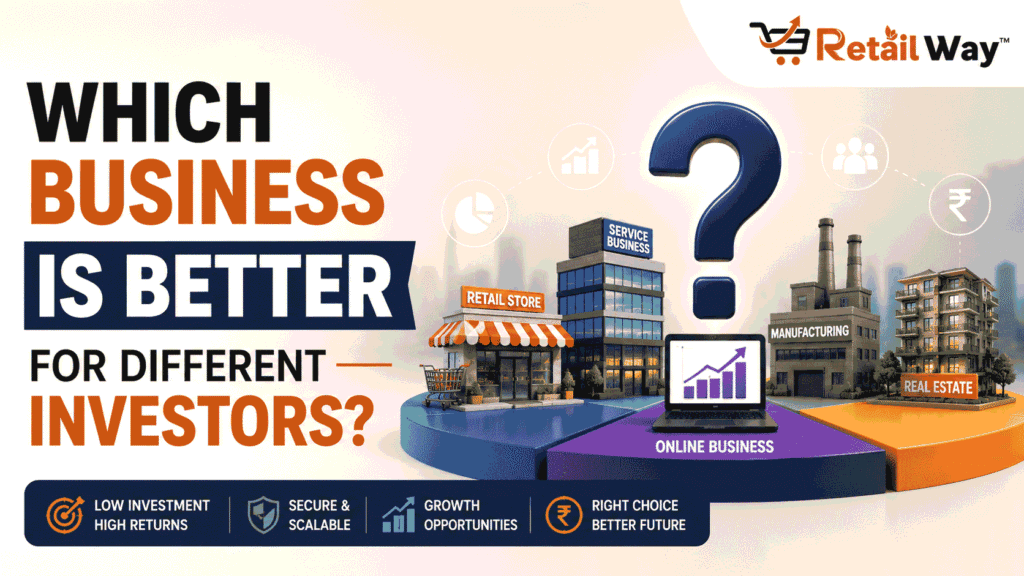
Which Business is Better for Different Investors?
| Investor Profile | Better Fit | Reasoning |
|---|---|---|
| Small budget (₹15–25 lakh) | Grocery shop franchise | The only realistic option at this capital level without dangerous over-leverage |
| First-time entrepreneur | Grocery shop franchise | Learn retail operations at a scale where mistakes are affordable and correctable |
| Experienced retailer | Supermarket franchise | Existing supplier relationships, team management skills and category knowledge all pay off at scale |
| Tier-2 city | Either — depends on catchment | Supermarkets work in developed pockets with parking; grocery shops work almost everywhere |
| Tier-3 town | Grocery shop franchise | Rent and demand density usually favour a smaller format; supermarket volumes are hard to sustain |
| Metro city | Supermarket franchise (with caution) | Metro rents make small formats hard to justify, but supermarket capital requirements are steep |
| Family-run business | Grocery shop franchise | Family labour covers most roles, dramatically improving the cost structure |
| Long-term expansion plan | Start with grocery shop, scale to supermarket | Build capital and operational capability across small stores first, then commit to large format |
| Owns commercial property | Supermarket franchise | Removing rent from the P&L transforms large-format economics |
| Passive/absentee investor | Neither, honestly | Both formats need daily owner involvement; consider a partner-operator model instead |
Factors to Consider Before Choosing
Budget — and specifically, budget after the buffer. Don’t calculate what you can afford to invest. Calculate what you can invest while keeping three months of running costs untouched in a separate account. That second number is your real budget. Running out of working capital in month four is the most common way new stores fail.
Location and catchment quality. Count footfall yourself, on a weekday evening and a Sunday morning. Estimate the resident population within 1 km. Check whether there’s parking — a supermarket without parking is a very expensive mistake. Walk the surrounding lanes and see how people currently shop.
Existing competition. Map every grocery store, kirana and branded outlet within 2 km. If a strong supermarket already serves the catchment, a competing supermarket is a hard fight, but a well-placed grocery shop closer to the residential pockets can still do well.
Genuine local demand. A town’s aspiration for a supermarket is not the same as its ability to sustain one. Look at what people actually buy: basket sizes, willingness to pay for packaged and branded goods, frequency of large shopping trips.
Brand reputation and support. Call five existing franchisees — ideally ones the brand did not introduce you to. Ask about supply delays, margin disputes and whether support continues after month six. This one step tells you more than any brochure.
Available space and its shape. A long narrow space is difficult for a self-service layout. Check the frontage, entrance width, ceiling height, power load and loading access before you fall in love with a location.
Your own management capability. Be honest here. Managing four people is a different job from managing sixteen across shifts and departments. If you have never run a team, a supermarket is a steep first climb.
Growth plans. If you want three stores in five years, a replicable small format gets you there faster and with better risk distribution. If you want one strong business you’ll run personally for twenty years, a supermarket in a good location makes sense.
Common Mistakes to Avoid
- Choosing the format before studying the catchment. Let the location tell you which model fits. Not the other way round.
- Building a supermarket in a grocery-shop market. The most expensive error in this category, and the most common among ambitious first-timers.
- Spending the working capital buffer on fit-out and stock. Beautiful store, full shelves, no cash for month two. It happens constantly.
- Signing a lease with steep annual escalation. A 10% yearly rent increase against a 6% net margin is a slow-motion problem.
- Overstocking the long tail at launch. Fill fast movers deep and slow movers thin. You can always add SKUs once you know what sells.
- Underestimating electricity for large formats. Chillers, freezers and full lighting across 3,000 sq ft produce a serious monthly bill. Check the commercial tariff before signing.
- Hiring the cheapest staff available. In self-service retail, shrinkage and customer experience both live with your team.
- Ignoring expiry discipline. Weekly near-expiry audits from week one, without exception.
- Trying to beat national chains on price. You will not win that fight. Compete on freshness, proximity, service and reliability of stock.
- Skipping legal review of the franchise agreement. Check territory protection, minimum purchase obligations, renovation clauses and exit terms.
- Treating either format as passive income. Both need you there.
- Neglecting your Google Business Profile. A large share of “grocery store near me” searches decide where someone walks that evening. Claim it, add real photos, keep timings accurate.
Expert Tips Before Investing
Spend two weeks doing fieldwork before you spend two lakh. Stand outside three stores in your city at 7 PM. Count people entering. Note how many leave with a full bag versus a single item. Talk to owners — most will speak openly to someone who isn’t a competitor. This costs nothing and teaches more than any report you can buy.
Start smaller than your ego wants and larger than your fear allows. Most people either overreach into a format they cannot manage or hold back into a space too small to be viable. The right answer is usually the largest format your catchment genuinely supports, not the largest one you can afford.
Model your break-even in writing before signing anything. Fixed monthly cost divided by gross margin percentage gives you the turnover you must achieve. If that number looks unrealistic for your catchment, you have your answer — and you got it before spending money.
Negotiate the lease harder than the franchise fee. Franchise fees are one-time. Rent compounds every month for a decade. Push for a longer lock-in in your favour, a capped escalation and a clear exit clause. Have a lawyer verify title and commercial usage permission.
Treat fresh produce as a decision, not a default. It drives footfall and margin, but it demands daily attention and disciplined wastage control. If you cannot commit to managing it properly, a tighter packaged-goods assortment will serve you better.
Build the WhatsApp channel from day one. A store list, a delivery boy for a 2 km radius, and a broadcast group for offers. Setup cost is close to nothing and the effect on basket size and repeat purchase is real. This is the single cheapest advantage available to independent franchisees right now.
Review category-wise numbers weekly for the first six months. Sales by category, shrinkage, footfall, basket size. Act on what the data says rather than what your instinct says. Instinct is useful in year three; data is essential in year one.
Plan the second store while running the first — but don’t open it until the first runs without you for a full month. That’s the real test of whether your systems work or whether you are the system.
Final Verdict
There is no single better option here, and any article that gives you a clean winner is oversimplifying a decision that depends heavily on your circumstances.
A grocery shop franchise is the stronger choice for most first-time investors, for Tier-2 and Tier-3 towns, for budgets under ₹30 lakh, for family-run operations, and for anyone who wants to learn retail properly before committing serious capital. It reaches break-even faster, forgives mistakes more cheaply, and replicates well.
A supermarket franchise is the stronger choice when you have substantial capital, a genuinely proven catchment with parking, prior retail or team-management experience, and ideally your own commercial property. Its earning ceiling is far higher, and a well-run supermarket becomes a serious business asset.
The honest framing is this: choose based on four things, in this order.
- Investment capacity — including the buffer, not just the launch cost.
- Market demand — what your specific catchment actually supports, measured rather than assumed.
- Business goals — one strong store, or a replicable cluster.
- Operational capability — the size of team you can genuinely lead.
Get those four right and either format can work. Get the catchment wrong and neither will.
Why Choose Retails Way?
Most people researching this decision run into the same problem: the information available is fragmented, and every brand only explains its own model. Nobody lays the options side by side.
Retails Way works in that space. It runs its own supermarket franchise model in India while also helping entrepreneurs understand the wider retail landscape — comparing formats, mapping realistic budgets, and thinking through which model suits a specific city and catchment before any capital gets committed.
What that involves in practice:
- Format guidance sized to real budgets. The Retail Way model operates in the 500–1,000 sq ft range, which fits first-time owners and Tier-2/Tier-3 locations far better than large formats requiring crores.
- Supply chain access. Franchise partners work with a network spanning 20,000+ products across 1,500+ brands — buying leverage no independent store can build alone.
- Site evaluation before commitment. Local demographics, spending patterns and footfall are assessed before a location is approved. Given how much of a store’s outcome is decided by location, this step carries real weight.
- Documentation and compliance support. GST, food licences, rent agreements and local registrations handled as a structured process.
- Operational support after opening. Stock refill planning, staff hiring and training, backend software and local branding — the part that decides whether year two beats year one.
- A budget planning tool on their site that lets you model franchise fee, deposit, software, purchasing and interior costs before speaking to anyone.
The useful thing about a conversation at this stage is clarity — including if you conclude that a different brand, a different format, or an independent store suits you better.
Conclusion
The comparison between a grocery shop franchise and a supermarket franchise comes down to fit, not to which format is superior. One is a neighbourhood habit business with a modest cost base and quick correction cycles. The other is a destination business with a far higher ceiling and a far higher cost of being wrong.
Both operate in a category with genuinely strong fundamentals. Grocery demand doesn’t disappear in a bad year, organised retail still has a long runway in India, and supply chains have matured to the point where a first-time owner in a district town can run a professional store — something that wasn’t realistic fifteen years ago.
What both models demand is the same: thin margins respected, working capital protected, shrinkage controlled, and an owner who shows up. Do the unglamorous work first. Count footfall yourself. Call existing franchisees the brand didn’t hand-pick for you. Model your break-even before you sign. Have a lawyer read the agreement and a CA read the numbers.
Evaluate your investment capacity, your local market and your own operational capability honestly, and the right format usually becomes obvious.
For entrepreneurs weighing these options, Retails Way is a useful resource for understanding retail formats, comparing franchise models, and getting practical insight into what a specific city and budget can realistically support. Take the time the decision deserves — a store built carefully can support a family for a generation.
Frequently Asked Questions
1. Is a grocery shop franchise better than a supermarket franchise?
Neither is universally better — they suit different investors and different locations. A grocery shop franchise generally works better for first-time entrepreneurs, budgets under ₹30 lakh, Tier-2 and Tier-3 towns, and family-run operations, because it breaks even faster and mistakes cost less to correct. A supermarket franchise makes more sense when you have substantial capital, a proven catchment with parking, and previous experience managing a larger team. The deciding factor should be your local catchment rather than personal preference. Measure footfall and household density in your target area first, then choose the format that market genuinely supports.
2. Which business requires less investment?
A grocery shop franchise requires considerably less. A typical 800 sq ft store in a Tier-2 city runs roughly ₹12–30 lakh all-in, covering franchise fee, deposits, interiors, racking, refrigeration, opening inventory, POS, licences, launch marketing and a working capital buffer. A supermarket franchise of around 3,000 sq ft usually starts near ₹45 lakh and can exceed ₹1.5 crore, driven mainly by rent deposit, fit-out, cold chain and a much larger inventory commitment. Costs vary sharply with city, rent, brand specifications and whether you already own the premises. Always keep three months of running costs aside separately.
3. Which business earns higher profits?
A supermarket has the higher absolute profit ceiling because of its turnover scale and its ability to stock high-margin categories like fresh produce, bakery, general merchandise and private label. However, net margins in both formats typically land between 4% and 10% for well-run stores, since the supermarket’s better gross margin is offset by much higher rent, payroll and electricity. Return on capital is often comparable, and a cluster of three grocery shop franchises can generate more combined profit than one supermarket with less concentrated risk. Profitability depends on location, category mix, shrinkage control and daily management more than on format.
4. Which business is easier for beginners?
A grocery shop franchise, clearly. The smaller format can be run by one committed owner with three or four staff, without a management layer. The monthly cost base is modest, which means a slow start or an assortment mistake is recoverable rather than fatal. Break-even typically arrives in 12–30 months versus 24–48 months for a supermarket. Most importantly, it teaches you the fundamentals — stock rotation, shrinkage control, category mix, customer patterns — at a scale where learning is affordable. Many successful supermarket owners in India started exactly this way and scaled up once their systems were proven.
5. How do I choose the right franchise model?
Work through four questions in order. First, what can you invest while keeping three months of running costs untouched? That buffer is non-negotiable. Second, what does your catchment actually support — count footfall, household density and existing competition yourself rather than assuming. Third, what are your goals: one strong store, or a replicable cluster across the city? Fourth, how large a team can you genuinely lead? Then shortlist two or three brands, request their official franchise disclosure documents, speak to existing franchisees they did not introduce you to, and have a CA review the numbers before committing.