
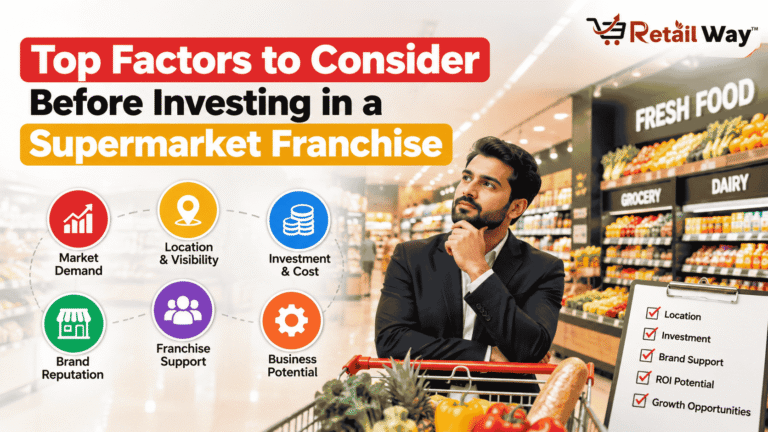
Top Factors to Consider Before Investing in a Supermarket Franchise
Connect Now
LATEST POST
Grocery is the one category Indians never stop buying. Food and grocery accounts for roughly two-thirds of the country’s total retail spend, yet organised retail still holds only a small share of that market. That gap is exactly why so many first-time entrepreneurs are drawn to a supermarket franchise today: a proven brand, a ready operating system, and a product people need every single day.
But a store that sells daily essentials is not automatically a store that makes daily profit. At Retail Way, we work with investors across India who are evaluating grocery and supermarket formats, and the same pattern repeats: the stores that succeed were chosen carefully, not quickly. This guide walks you through the factors that actually decide whether your investment pays off — in the order you should evaluate them.
1. Understand the Real Economics of Grocery Retail
Before you look at any brand, understand the business model itself. Supermarkets are a high-volume, low-margin game. Gross margins on FMCG and staples typically sit between 12% and 20%, while net profit after rent, salaries, electricity and wastage usually lands in the 2% to 5% range for a well-run store. Fresh produce, private-label products and in-house bakery or dairy counters push margins higher; packaged staples pull them lower.
That means two things for you as an investor. First, your break-even depends almost entirely on footfall and basket size, not on pricing power. Second, a 1% improvement in shrinkage or a 5% improvement in product mix can move your annual profit by lakhs. If you want a deeper breakdown of category-wise margins and realistic ROI timelines, read our guide on supermarket profit margins in India before you go any further.
2. Calculate the Total Investment — Not Just the Franchise Fee
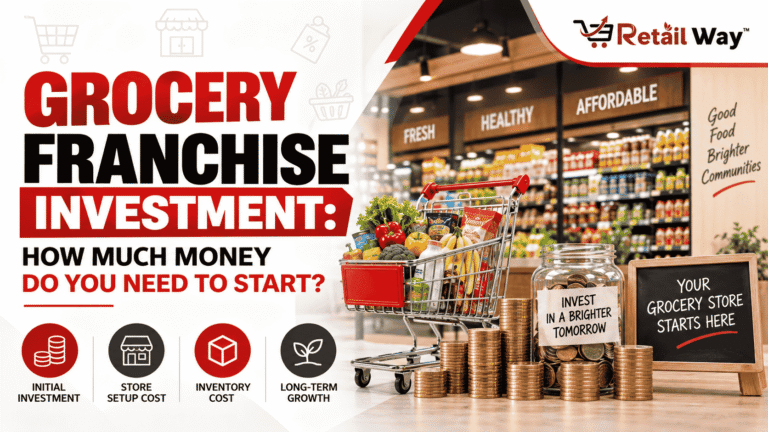
Most brands advertise a franchise fee between ₹2 lakh and ₹10 lakh, and many investors mistake that for the cost of entry. The franchise fee is usually the smallest line item. A realistic budget for a 1,500 to 3,000 sq ft store in a Tier 2 city looks closer to this:
| Cost Head | Typical Range (INR) |
|---|---|
| Franchise fee / brand licence | 2 – 10 lakh |
| Interior, fit-out and signage | 10 – 25 lakh |
| Racks, chillers, billing counters, CCTV | 8 – 15 lakh |
| Opening stock (first fill) | 15 – 40 lakh |
| Security deposit (6–12 months’ rent) | 3 – 12 lakh |
| Working capital (first 3–6 months) | 10 – 20 lakh |
| Total | ₹50 lakh – ₹1.2 crore |
Add 10% to 15% as a contingency for delays, licences and pre-opening marketing, and ask every brand whether royalty is a flat fee or a percentage of sales — a 2% royalty on ₹50 lakh of monthly sales is ₹1 lakh every month. Our detailed grocery franchise investment guide breaks each of these cost heads down city-wise so you can build an honest budget.
3. Location and Catchment Analysis
In grocery retail, location is not one factor among many — it is the factor. A supermarket survives on repeat visits from a 1.5 to 3 km radius, so your catchment needs enough households with enough purchasing power to generate daily footfall of at least 300 to 500 bills.
Before you sign a lease, physically validate:
- Household density: Count residential towers, colonies and new housing projects within 2 km. A minimum of 3,000 to 5,000 households is a reasonable threshold for a mid-size store.
- Competition map: Note every kirana cluster, existing supermarket, and quick-commerce dark store nearby. Direct competition is manageable; three stores of the same size on one road is not.
- Visibility and access: Ground-floor frontage, two-wheeler and car parking, and a road that people already use for their daily commute.
- Rent-to-sales ratio: Rent should stay under 5% to 7% of projected monthly sales. If a prime location pushes rent to 12%, the numbers rarely recover.
Spend at least two weekends and two weekdays observing footfall at the site. This single exercise has saved our clients from more bad decisions than any spreadsheet.
4. Choose the Right Franchise Model
Not every brand offers the same arrangement, and the model you pick decides how much control, risk and profit you keep. The three common structures in India are:
- FOFO (Franchise Owned, Franchise Operated): You invest, you run the store, and the brand provides the name, supply chain and SOPs. Highest profit share, highest operational responsibility.
- FOCO (Franchise Owned, Company Operated): You invest, the brand’s team operates the store, and you receive a fixed return or revenue share. Lower effort, lower upside, and you must verify the brand’s track record of actually delivering the promised return.
- COFO (Company Owned, Franchise Operated): Rare in grocery, mostly used for expansion into new cities.
A working professional with capital but no time usually leans FOCO; a family with retail experience should look hard at FOFO. We have compared these in detail in our article on choosing the right franchise model so you can match the structure to your situation.
5. Supply Chain, Pricing and Product Mix
The brand’s supply chain is the engine of your store, and you need to inspect it before you commit. Ask these questions directly to the franchisor and, ideally, to two or three existing franchisees:
- Where is the nearest distribution centre, and how often does it deliver to my city?
- What percentage of SKUs come through central procurement versus local vendors?
- What is the fill rate — how often does the brand deliver what the store ordered?
- Is there a private-label range? Private label typically earns 25% to 35% gross margin versus 12% to 15% on national brands, making it one of the strongest profit levers in a supermarket franchise.
- How is fresh produce sourced, and who absorbs the wastage?
A brand that leaves 60% of procurement to you is essentially a signboard — you will be running an independent store with a royalty attached.
6. Training, Technology and Ongoing Support
Franchise support is where good brands separate themselves from the rest. Look for:
- Pre-opening support: Store layout, planogram design, hiring assistance and a launch marketing plan.
- POS and inventory software: A real-time billing and stock system linked to the brand’s warehouse. Manual stock-keeping is the fastest route to shrinkage; our piece on supermarket inventory management tips explains how much poor stock control quietly drains every month.
- Staff training: Cashier, floor and store-manager training, with quarterly refreshers.
- Marketing: Festival campaigns, loyalty programmes and digital presence that the brand funds or co-funds.
- Field visits: A dedicated franchise manager who visits at least monthly in the first year.
Ask how many stores each support manager handles. If one person covers 60 stores, your support will be a WhatsApp group.
7. Verify the Brand’s Track Record
A franchise is only as valuable as the brand behind it. Do your own due diligence rather than relying on the brochure:
- Ask for total stores opened versus currently operational. The gap is the closure rate, and it tells you more than any testimonial.
- Speak to at least three existing franchisees the brand did not hand-pick. Ask about actual monthly sales, royalty disputes and delivery reliability.
- Check the parent company’s incorporation date, directors and litigation on the MCA portal.
- Visit two or three operating stores unannounced on a weekday afternoon and a Sunday evening.
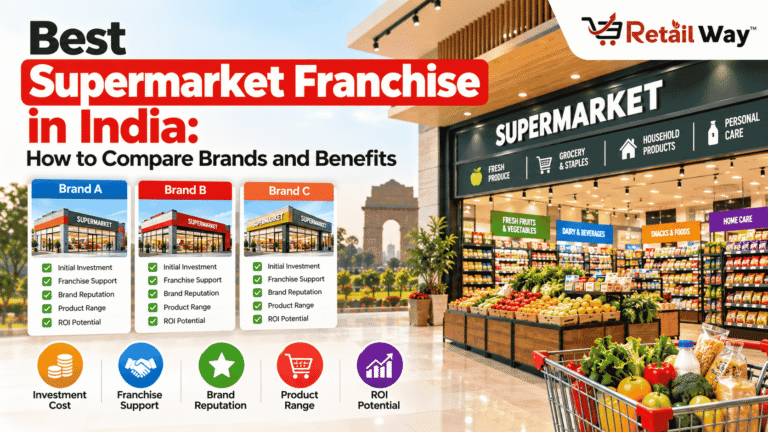
If you are still shortlisting, our comparison of the top franchise brands in India covers investment size, store count, royalty structure and support quality for the major players, so you can evaluate them side by side.
8. Read the Franchise Agreement Line by Line
Have a lawyer review the agreement before you sign, and pay particular attention to:
- Term and renewal: Most agreements run 3 to 5 years. What is the renewal fee, and can the brand refuse renewal?
- Territory exclusivity: Does the brand promise not to open another store within a defined radius? Get the radius in writing.
- Exit and termination clauses: What happens to your stock, interiors and deposit if either side exits early?
- Minimum purchase commitments: Some brands require you to buy a fixed value of stock monthly regardless of sales.
- Transfer rights: Can you sell the store to another investor if needed?
These clauses rarely matter in year one. They matter enormously in year three.
9. Build a Realistic ROI Timeline
A well-located, well-run supermarket franchise in India typically reaches operational break-even within 6 to 12 months and recovers the full investment in 2.5 to 4 years. If a brand promises full payback in 12 months, treat that as a red flag, not an opportunity.
Project conservatively: assume 60% of the brand’s projected sales for months one to three, 80% for months four to six, and 100% only from month seven, and keep six months of working capital in reserve. The investors who struggle rarely have bad stores — they ran out of cash before the store matured.
10. Assess Your Own Readiness
Finally, be honest about yourself. Grocery retail is a 12-hour-a-day, 7-day-a-week business with thin margins and constant operational decisions. Even in a FOCO model you will need to review reports and cash flow and step in when things go wrong. If you have never managed staff or perishable inventory, start with a smaller format or partner with an experienced operator.
Conclusion
A supermarket franchise can be one of the most stable retail investments in India, precisely because people buy groceries in every economic cycle. But stability comes from the decisions you make before opening day — the catchment you choose, the model you sign, the supply chain you verify, and the cash reserve you keep.
At Retail Way, we help investors evaluate brands, locations and financial projections before they commit, so the decision is based on data rather than a sales pitch. If you are considering a grocery or supermarket format, go through each of the ten factors above with real numbers from your city — and if you would like a second opinion on your shortlist, the Retail Way team is here to help you make a confident, well-informed decision.