
Is a Grocery Franchise a Good Business Opportunity in India?
Connect Now
LATEST POST
Walk into any neighbourhood in India on a Sunday morning and you will see the same thing: a steady line of families buying atta, dal, oil, milk and snacks. Grocery is the one category that never goes out of demand. That is exactly why so many first-time entrepreneurs, salaried professionals and existing shop owners are asking the same question today: is a grocery franchise a good business opportunity in India, or is it just another trend?
At Retail Way, we work with franchise partners across Tier 1, Tier 2 and Tier 3 cities, and we have seen both sides of this business. In this guide, we share what the data says, what actually happens on the ground, and how you can decide whether this model is right for you.
Your Own Supermarket Is Just One Call Away
20,000+ products, 1,500+ brands & complete setup support.
Why Grocery Is a Recession-Proof Category
Food and grocery is the largest segment of Indian retail. Industry estimates place the overall Indian grocery market at well over $600 billion, with projections of close to $1 trillion by FY30. Within this, organised retail (supermarkets, chains and franchises) still holds a relatively small share compared to traditional kirana stores, which means the growth runway for organised formats is enormous.
Three structural shifts are driving this:
- Rising household incomes: Middle-class families now prefer clean, air-conditioned stores with billing, discounts and branded products.
- Urbanisation in smaller cities: Tier 2 and Tier 3 towns such as Lucknow, Indore, Patna, Ranchi and Coimbatore are seeing new residential clusters with no modern grocery store nearby.
- Trust in brands: Customers prefer buying packaged staples and FMCG from a recognised brand that guarantees quality, fair weight and MRP billing.
Unlike fashion, electronics or restaurants, grocery demand does not fall during a slowdown. People may postpone buying a phone, but they will not postpone buying rice. This repeat, non-discretionary demand is the single biggest reason a franchised grocery store is considered a safer entry point into retail.
What Does the Franchise Model Actually Include?
A grocery franchise is a business arrangement where you (the franchisee) open and operate a supermarket or grocery store under an established brand (the franchisor). In return for a franchise fee and ongoing royalty or margin-sharing, the brand provides:
- Store layout, branding and interior design
- Supply chain and centralised procurement of products
- Billing software, inventory management and POS systems
- Staff training and standard operating procedures
- Marketing support, offers and launch campaigns
In simple words, you bring the capital, the location and the commitment. The brand brings the system. If you are still comparing formats, our detailed franchise investment guide for beginners explains how different models are structured.
Advantages of the Franchise Route in India
1. Faster break-even compared to independent stores
An independent grocery store owner spends months negotiating with 40–60 distributors, figuring out shelf planning and learning inventory control through trial and error. A franchisee gets all of this on day one. In our experience at Retail Way, well-located franchise stores typically reach monthly operational break-even within 8 to 14 months, while independent stores often take 18 to 24 months.
2. Better margins through bulk procurement
Grocery is a volume business with thin margins. A standalone store buying from local distributors earns 8–12% blended gross margin. A franchise brand that procures centrally for 50, 100 or 500 stores negotiates far better rates, and passes a share of that benefit to franchisees. This is one of the most underrated reasons the franchise model works in grocery.
3. Lower learning curve for first-time owners
Most people entering this business have never run a retail store. The franchise system removes guesswork around pricing, shrinkage control, expiry management and staff rostering. Standardised SOPs mean a store in Nagpur runs the same way as a store in Noida.
4. Brand pull from the first day
Customers walk into a known brand with higher trust. Launch marketing, festival offers and loyalty programs are handled centrally, which is a huge relief for an owner managing daily operations.
5. Scalability
Once your first store stabilises, opening a second or third outlet is far easier because the systems, vendor relationships and trained staff already exist. Many of our most successful partners own two to four stores within three to four years.
The Risks and Realities You Should Know
Any honest assessment must cover the downside too. This is not a passive income scheme, and anyone promising guaranteed returns should be treated with caution.
- Thin margins demand high footfall. You need daily sales volume. A wrong location with low catchment population can make even a great brand struggle.
- Working capital is continuous. Inventory must be refilled every week. Fresh categories like fruits, vegetables and dairy carry wastage risk if not managed well.
- Royalty and fees reduce profit. Franchise fees, royalties or margin-sharing are the cost of the system. You must calculate net profit after these payments, not before.
- Competition from quick commerce. Blinkit, Zepto and Instamart have changed buying habits in metros. However, their penetration in Tier 2 and Tier 3 cities is still limited, and in-store shopping for monthly staples continues to dominate.
- Dependence on the franchisor. If the brand’s supply chain is weak, your shelves stay empty. Always check the brand’s existing stores before signing.
We have covered these points in more depth in our article on the pros and cons of supermarket franchise, which is worth reading before you commit.
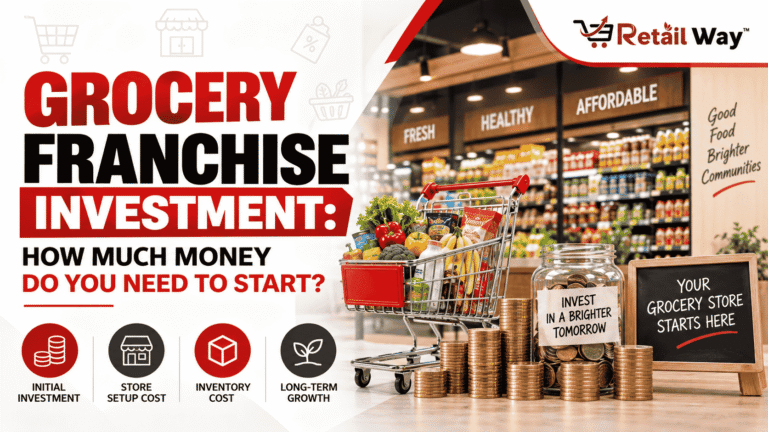
How Much Does It Cost? A Realistic Investment Breakdown
Investment depends on store size, city and brand. Here is a practical range based on current market conditions:
| Store Format | Area | Approx. Investment | Typical Monthly Sales Potential |
|---|---|---|---|
| Mini Mart / Convenience | 300–600 sq. ft. | ₹8–15 lakh | ₹8–15 lakh |
| Standard Supermarket | 800–1,500 sq. ft. | ₹18–35 lakh | ₹20–45 lakh |
| Large Supermarket | 2,000–4,000 sq. ft. | ₹40 lakh–₹1 crore | ₹50 lakh–₹1.2 crore |
This typically covers franchise fee, interiors, racks, refrigeration, billing systems, initial inventory and launch marketing. Rent deposit and working capital for the first three months should be budgeted separately. You can use our franchise budget planning tool to get a store-specific estimate.
A healthy grocery store earns a net profit margin of 4–8% on sales after all expenses, including royalty, rent, salaries and electricity. On monthly sales of ₹30 lakh, that translates to ₹1.2–2.4 lakh net profit per month, with a payback period of roughly 2 to 3.5 years.
Who Is This Business Right For?
From our experience onboarding partners across India, this business suits:
- Working professionals with ₹20–40 lakh savings who want a stable, operator-led business rather than a speculative one
- Existing kirana or general store owners who want to upgrade to a modern format and compete with organised chains
- Real estate owners with a 1,000+ sq. ft. commercial space on a main road or inside a residential society
- Family businesses where one member can be present at the store daily
It is less suitable for people who want a completely hands-off investment. Grocery rewards presence. The owners who visit their store daily, know their regular customers and watch their fast-moving SKUs consistently outperform absentee owners.
Five Things to Check Before You Sign Any Agreement
- Visit at least three existing stores of the brand in different cities and talk to the owners privately about actual sales and support quality.
- Ask for the Franchise Disclosure Document and read the royalty, exit and territory clauses carefully.
- Study your catchment area: at least 3,000–5,000 households within a 1–2 km radius, with limited organised competition.
- Verify the supply chain: does the brand have a regional warehouse near your city, or will stock take seven days to arrive?
- Understand the technology: modern billing, inventory alerts and loss-prevention systems are non-negotiable in 2026.
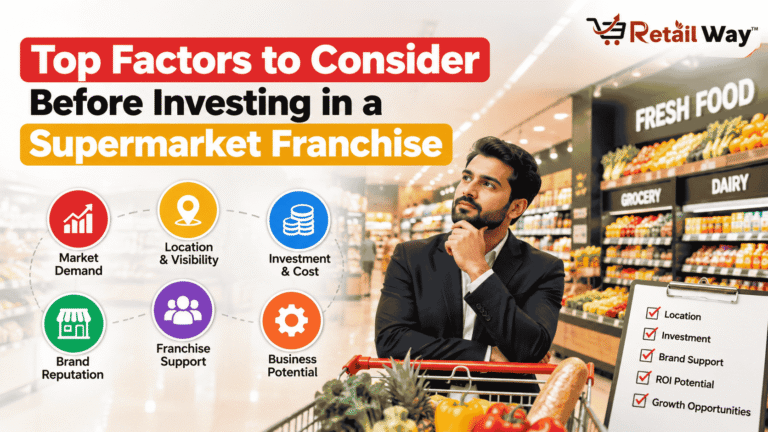
For a complete checklist, read our guide on factors before investing in franchise.
Franchise vs. Starting Independently
Many entrepreneurs ask whether they should skip the franchise and open their own store to save on fees. It is a fair question. Independence gives you full control and zero royalty. But it also means you build procurement, systems, branding and training from scratch, which is where most first-time retailers lose money and time.
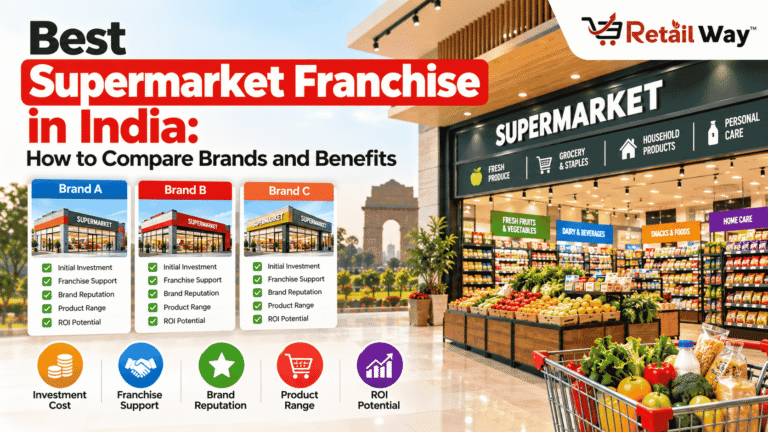
The franchise route trades a share of profit for speed, lower risk and proven processes. For most first-time owners, that trade is worth it. Our comparison of a supermarket franchise vs independent store goes deeper into the numbers.
The Verdict: Is It a Good Opportunity?
Yes, a grocery franchise is one of the strongest business opportunities in India right now, provided you treat it as a serious operating business and not a side investment. The fundamentals are in your favour: non-discretionary demand, low organised retail penetration, rapidly growing Tier 2 and Tier 3 markets, and a model that gives first-time entrepreneurs a proven system from day one.
The success factors are equally clear: the right location, adequate working capital, a franchisor with a strong supply chain, and an owner who is present and involved.
Your Own Supermarket Is Just One Call Away
20,000+ products, 1,500+ brands & complete setup support.
Conclusion
Grocery retail is the backbone of Indian consumption, and the shift from unorganised kirana to organised supermarkets is still in its early stages. For an entrepreneur who wants predictable demand, repeat customers and a scalable model, a franchised grocery store offers a rare combination of stability and growth.
At Retail Way, we have built our franchise model around what franchisees actually need: strong centralised procurement, transparent margins, regional supply support and hands-on training before and after launch. If you are evaluating a supermarket or grocery franchise in India, we would be happy to walk you through store formats, investment options and realistic returns for your city.
Talk to the Retail Way team today and take the first step towards owning a store that your neighbourhood shops at every single day.