
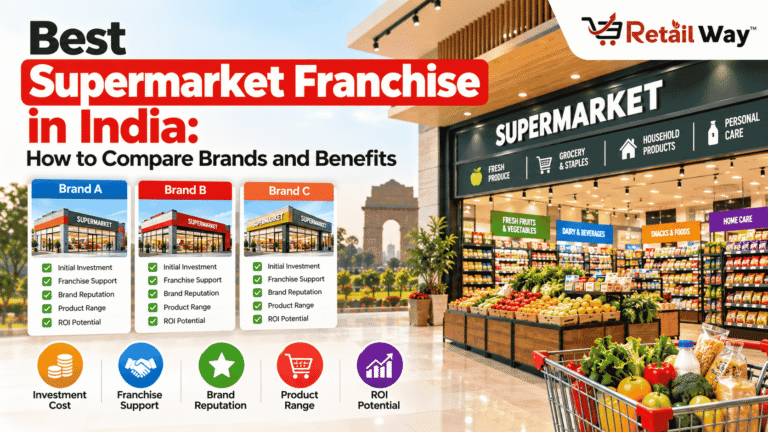
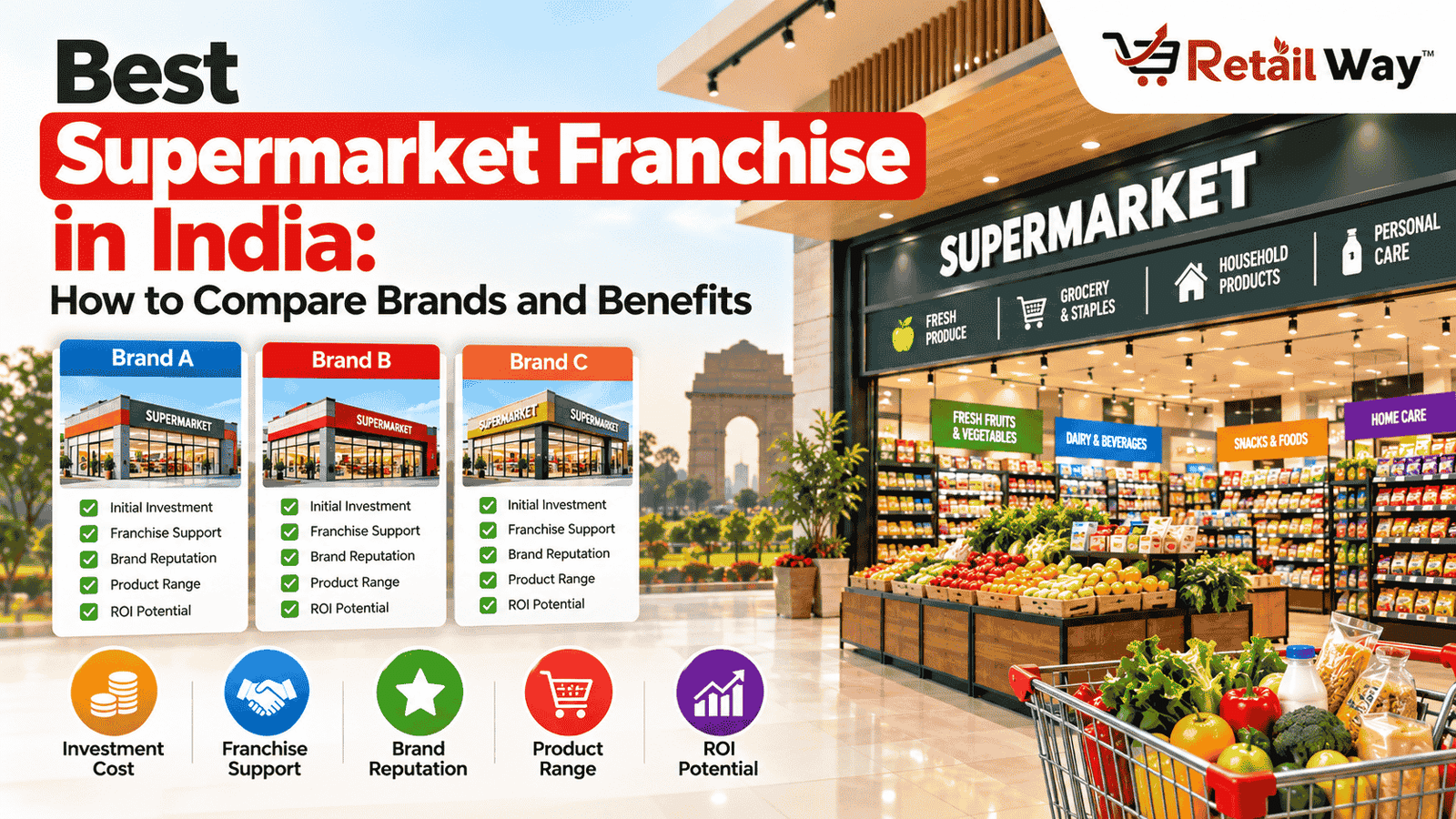
Best Supermarket Franchise in India: How to Compare Brands and Benefits
Connect Now
LATEST POST
Organised grocery retail in India is growing fast, yet more than 85% of the country’s food and grocery sales still happen through traditional kirana stores. That gap is exactly why so many first-time investors are searching for the best supermarket franchise in India right now. A franchise gives you a tested brand, a working supply chain and a store format that customers already trust, instead of starting from zero.
The problem is that every brand’s brochure looks good. The real question is not “which brand is popular?” but “which brand’s numbers, support and terms actually fit my location, my budget and my goals?” This guide shows you how to compare supermarket franchise brands point by point, so you can make a confident decision rather than an emotional one.
What Does “Best” Actually Mean in a Supermarket Franchise?
There is no single best brand for everyone. A chain that works brilliantly in a Tier-1 metro may struggle in a Tier-3 town where customers expect credit, home delivery and local brands on the shelf. When we work with investors, we ask them to define “best” using five filters:
- Fit with your budget – total investment, not just the franchise fee.
- Fit with your location – catchment size, competition and footfall.
- Realistic margins – gross margin on the product mix, not headline claims.
- Depth of support – what the franchisor does for you after the opening day.
- Exit flexibility – contract length, renewal terms and resale rights.
Once you score brands on these five points, the “best supermarket franchise” becomes a shortlist of two or three rather than a confusing list of twenty.
Step 1: Compare the Total Investment, Not Just the Franchise Fee
The franchise fee is usually the smallest part of the bill. A typical grocery franchise in India requires you to budget for:
- Franchise or brand fee: one-time, often ₹2–10 lakh depending on the brand and store size
- Interior and fit-out: racks, chillers, billing counters, signage, lighting
- Opening inventory: usually the single largest cost; grocery stores carry 3,000–8,000 SKUs
- Software and hardware: POS, inventory system, CCTV, barcode scanners
- Security deposit and rent advance: typically 3–6 months’ rent in most Indian cities
- Working capital: at least 2–3 months of salaries, utilities and restocking
Ask each brand for a line-item investment sheet, then add 10–15% as a buffer for delays and local approvals. If a brand refuses to share a detailed breakup, treat that as a warning sign. If you want a quick estimate before talking to any brand, you can check your franchise budget here and see how different store sizes change the total.
Expert tip: Compare investment per square foot across brands. A franchise quoting ₹3,500 per sq. ft. all-inclusive is easier to evaluate than one quoting a “starting from” figure that excludes inventory.
Step 2: Understand the Margin Structure
Supermarket retail is a volume game with thin margins. Across India, blended gross margins for grocery stores typically range from 12% to 22%, depending on the share of packaged food, fresh produce, personal care and private-label products. Brands with a strong private-label range can push margins higher because they control the sourcing.
When comparing brands, request the following:
- Category-wise margin sheet (staples, FMCG, fresh, personal care, household)
- Private-label share of total sales and its margin
- Royalty or revenue share – is it a fixed monthly amount or a percentage of sales?
- Mandatory purchase rules – do you have to buy 100% stock from the franchisor, or can you source local items?
A brand charging 2% royalty but allowing 30% local sourcing can be more profitable than a brand charging 0% royalty but forcing you to buy everything at a lower margin. For a detailed look at how these numbers translate into monthly profit, read our guide on supermarket profit margins in India.
Step 3: Evaluate the Supply Chain and Fill Rate
This is where many franchisees get hurt, and it rarely shows up in the sales pitch. A franchise brand is only as good as the stock it delivers to your store on time. Ask every shortlisted brand:
- What is your average fill rate (percentage of ordered items actually delivered)? Anything below 85–90% means empty shelves and lost customers.
- How many delivery days per week do you offer in my city or district?
- Do you operate your own distribution centre within 150–200 km of my location?
- What is your return and expiry policy on slow-moving or near-expiry stock?
If possible, visit two existing franchise stores unannounced on a weekday and count the empty shelf space. That five-minute walk tells you more than any presentation.
Step 4: Compare the Support Package
The word “support” appears in every franchise brochure. The way to compare brands is to break it into specific, verifiable items:
| Support Area | Questions to Ask |
|---|---|
| Site selection | Do they visit the site and share a catchment report? |
| Store design | Is layout and planogram provided, or do you hire your own designer? |
| Staff training | How many days of training, and is it on-site or at head office? |
| Marketing | Are opening-day campaigns, festival promotions and digital ads included? |
| Technology | Is the POS and inventory software included, or billed separately? |
| Ongoing review | Is there a dedicated manager who reviews your sales monthly? |
Brands that offer structured launch support often see faster break-even for their partners, because the first 90 days decide whether a store becomes a habit for neighbourhood customers. Before you shortlist, go through our checklist on what to check before signing so you do not miss a critical clause.
Step 5: Read the Agreement Terms Carefully
Franchise agreements in India are often 5 to 9 years long. Compare these clauses across brands:
- Territory protection: Will the brand open another outlet within 1–2 km of your store?
- Renewal fee: Is renewal free, or is there a fresh fee after the first term?
- Transfer and resale rights: Can you sell the store to another investor?
- Exit penalties: What happens if you want to close early?
- Minimum performance clauses: Are there sales targets that trigger termination?
Hire a lawyer who has reviewed franchise agreements before. The ₹10,000–25,000 you spend on legal review is small compared to a 7-year commitment. Weighing these risks against the benefits is easier when you understand the full pros and cons of franchising in the Indian grocery context.
Step 6: Talk to Existing Franchisees
No brand will connect you to unhappy partners, so do your own research. Find 3–5 existing franchisees through Google Maps, LinkedIn or local business groups and ask:
- How long did it take to reach monthly break-even?
- Does the brand deliver on the promised margins?
- How quickly does head office respond when there is a problem?
- Would you open a second store with this brand?
Honest answers from current owners are the single most reliable data point in your comparison, and they cost you nothing but a few phone calls.
Key Benefits of a Supermarket Franchise vs. Going Independent
When done right, a grocery franchise offers advantages that are difficult to build alone:
- Brand trust from day one: customers already know the name, which shortens the time it takes to build regular footfall.
- Negotiated purchasing power: franchisors buy in bulk, so your landing cost is usually lower than an independent store’s.
- Proven store format: planograms, pricing strategies and promotion calendars are already tested.
- Technology included: inventory, billing and loyalty systems that would cost lakhs to build independently.
- Lower failure risk: a structured system reduces the trial-and-error phase that sinks many independent stores in year one.
The trade-off is reduced freedom in product selection and a share of revenue going to the franchisor. For many first-time retailers, that trade is worth it. If you are still deciding on the model, our comparison of supermarket franchise vs independent store walks through both options in detail.
A Simple Scorecard to Compare Brands
Take your shortlisted brands and score each one from 1 to 5 on the points below. Multiply by the weight, then total the score.
| Criteria | Weight | Brand A | Brand B | Brand C |
|---|---|---|---|---|
| Total investment vs. your budget | 20% | |||
| Blended gross margin | 20% | |||
| Supply chain fill rate | 20% | |||
| Launch and ongoing support | 15% | |||
| Agreement flexibility | 15% | |||
| Feedback from existing franchisees | 10% |
A brand scoring 4+ out of 5 on a weighted basis is a strong candidate. If no brand crosses 3.5, you may want to expand your search or revisit your budget.
Common Mistakes to Avoid
Based on the enquiries we handle every month, these are the mistakes that cost investors the most:
- Choosing by brand popularity alone – a famous name does not guarantee profitability in your specific location.
- Ignoring working capital – many stores struggle in months 3 to 6 because owners spent everything on fit-out.
- Skipping the site study – a store 200 metres from a crowded market can underperform if parking and visibility are poor.
- Not verifying margin claims – always ask for actual store P&L data, not projections.
- Signing without legal review – one unfavourable clause can lock you in for years.
Conclusion
Finding the best supermarket franchise in India is less about picking the biggest name and more about matching the right brand to your budget, location and long-term plan. Compare total investment honestly, look past headline margins to the actual product mix, test the supply chain, verify the support package, and read every clause before you sign. A grocery franchise can be a stable, scalable business when the fundamentals are right, and a frustrating one when they are not.
At Retail Way, we help investors evaluate supermarket franchise opportunities with transparent cost sheets, realistic margin data and hands-on launch support, so you can open a store that is built to grow. If you are ready to take the next step, explore our guide on how to start a supermarket franchise or speak to the Retail Way team for a free consultation.
Your own supermarket is one call away
20,000+ products, 1,500+ brands and complete setup support, from site survey to store opening.
Frequently Asked Questions
How much does a supermarket franchise cost in India? Depending on store size and brand, the total investment typically ranges from ₹15 lakh for a compact store to ₹1 crore or more for a large-format outlet. This includes franchise fee, interiors, inventory and working capital.
What is a good profit margin for a grocery franchise? A blended gross margin of 15–20% is considered healthy for Indian supermarket retail. Net margins after rent, salaries and royalty usually fall between 4% and 8% once the store is stable.
How long does it take to break even? Most well-located supermarket franchises reach monthly operational break-even within 6 to 18 months. The payback period on total investment is usually 2.5 to 4 years.
Can I run a supermarket franchise in a small town? Yes. Tier-2 and Tier-3 towns often have lower rent and less organised competition, which can improve margins. The key is choosing a brand whose supply chain reaches your area reliably.